Forces, steering, and springs
This section has one path: learn how small forces combine, practice with one seeking swarm and spring pair, then solve one tested force-system problem.
- Lesson: understand force composition
- Practice: calculate, run, and repair
- Exercise: design a tested force instrument
Lesson
One system, two behaviors
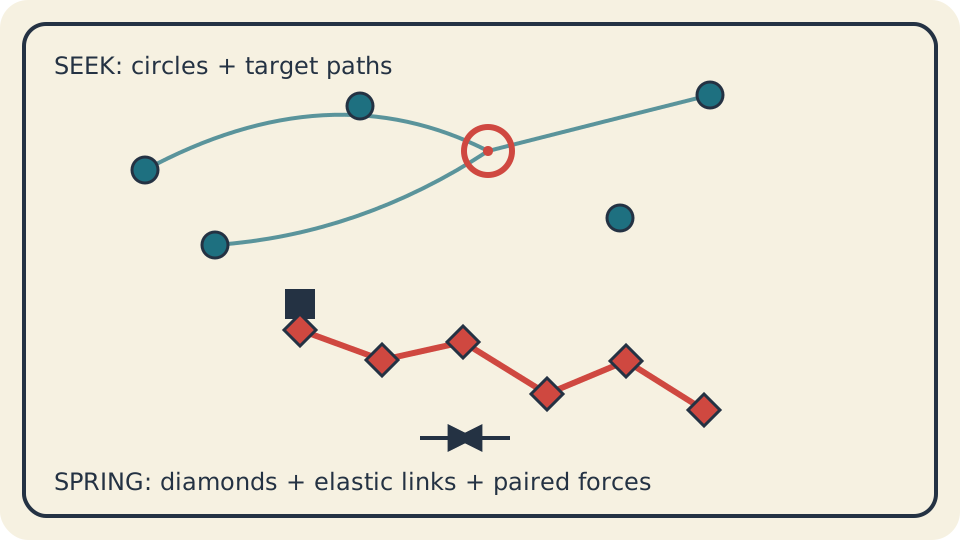
The same limited group becomes a seeking swarm or an elastic chain by combining small forces.
In this model, a force is a request to change velocity. Seeking compares the velocity an agent wants with the velocity it has. A spring measures how far two endpoints are from their resting distance, while damping removes motion along the spring so it can settle.
A scoped enum class
names the seek and spring_chain modes. The mode selects which small force
functions contribute to one accumulator; it does not create a second simulation
loop.
Accumulate, limit, integrate, clear
Every fixed step follows one order:
clear force
compose behavior forces into force
force = limit(force, maximum_force)
velocity = limit((velocity + force / mass * dt) * exp(-damping_rate * dt), maximum_speed)
position = position + velocity * dt
clear force
The new velocity moves position, an order called semi-implicit Euler. All agents receive their contributions before any agent integrates, so function order does not secretly give one object an early update. Maximum force limits how quickly motion changes; maximum speed separately limits the resulting movement.
Seek compares desired and current velocity
Let d = target - position. Away from the target, desired velocity is the unit
direction of d multiplied by maximum speed. Inside the arrival radius, speed
shrinks by distance / arrival_radius:
seek force = (desired_velocity - velocity) * mass / fixed_dt
A radial attraction or repulsion uses softened distance:
force = unit(source - position) * strength / (distance squared + softening squared)
Positive strength attracts and negative strength repels. At exact coincidence
there is no direction to normalize, so the honest answer is {0, 0}. Positive
softening prevents huge near-zero values. Pair repulsion applies equal and
opposite forces before caps and boundaries.
Springs restore distance and damp along their axis
A Hooke-like force is proportional to extension from rest length. This model asks for the force on the first endpoint and points its axis from first to second:
force_on_first = axis * stiffness * (distance - rest_length)
Put endpoints at x = 0 and x = 20, with rest length 10 and stiffness 2. The
first receives +20; the second receives -20. At distance 10 the force is
zero. Compression makes the scalar negative and pushes the pair apart.
Damping uses the dot product of relative velocity and the spring axis. If the
second endpoint approaches the first at 10 units per second and axial damping is
1, that dot product is -10, so the first endpoint’s force becomes
20 + 1 × -10 = 10. Sideways motion has a zero axial dot product.
Fixed-step transitions and adapter controls
Keys 1 and 2 choose a mode; Space toggles it. A mode change clears partial accumulator time and old forces so a half-step from one mode cannot run under the other. The bounded accumulator follows the fixed-timestep technique and reports dropped catch-up work. The model rejects unusable calculations, limits the system to 64 agents, includes each radius in boundary checks, and reverses only velocity pointing out of the window.
Pointer, drag, and arrow events move the same target or anchor through the openFrameworks event adapter . P pauses, R resets, and M freezes motion while leaving current shapes visible. The renderer clamps visible controls including stroke width and draws geometry inside each model radius. Tests inspect forces and state, not GPU pixels.
Practice
Practice is guided and has no unit-test gate. Work one spring by hand, trace one seek update, run both modes, and repair one visible stale-force mistake.
1. Replay the spring arithmetic
Read the independent values:
cat exercises/10-forces-steering-and-springs/fixtures/spring-oracle.txt
On Windows Developer PowerShell:
Get-Content .\exercises\10-forces-steering-and-springs\fixtures\spring-oracle.txt
Confirm the equilibrium, stretched, and stretched-plus-damping results are 0, 20, and 10. Then reverse the endpoint order: the magnitudes stay the same while the axis and paired signs reverse.
2. Trace one seek update
Choose an agent at (100, 100), a target at (130, 100), zero current
velocity, maximum speed 60, mass 1, and fixed step 1/60. The desired velocity
is (60, 0). Before the configured force cap, the seek request is
(60 - 0) × 1 / (1/60) = (3600, 0). Locate the cap and semi-implicit update in
shared/force_model.cpp, then predict why changing maximum force affects
responsiveness without changing maximum speed.
3. Run the two modes
Set OF_ROOT to openFrameworks 0.12.1. Linux or macOS:
scripts/section-10.sh generate --project starter
scripts/section-10.sh build --project starter --configuration Release
Launch exercises/10-forces-steering-and-springs/starter/bin/starter on Linux,
or open the generated .app on macOS. On Windows Developer PowerShell:
.\scripts\section-10.ps1 generate -Project starter
.\scripts\section-10.ps1 build -Project starter -Configuration Release
& .\exercises\10-forces-steering-and-springs\starter\bin\starter.exe
Press 1 and move the ring with pointer and arrows. Watch arrival slow near the target. Press 2 and compare stretched, compressed, and rest-length links. Try Space, P, R, M, every edge, and a viewport narrower than one agent diameter.
4. Repair stale accumulated force
In exercises/10-forces-steering-and-springs/shared/force_model.cpp, temporarily
remove clearForces(next); near the start of composeForces. Rebuild and run
the app. Old requests now leak into later steps, so motion keeps strengthening
instead of responding cleanly to the current mode. Restore the call and confirm
the behavior settles again.
If that was your only intended edit:
git restore -- exercises/10-forces-steering-and-springs/shared/force_model.cpp
That command discards every uncommitted change in the named file.
Exercise
Problem: create a switchable force instrument
Create a chain or swarm with seek and spring-chain modes whose geometry differs from both supplied examples. Choose the force caps, equilibrium, damping, boundaries, mode cues, and reduced-motion appearance. Preserve positive softening, paired spring forces, finite guards, the fixed-step/drop rule, the hard agent cap, keyboard mode access, pause, and reset.
Use the switchable force instrument exercise brief as the authoritative source for editable files, controls, constraints, fixtures, and the explained solution.
Run the unit tests
Linux or macOS:
CXX=g++ tests/run-section-10-tests.sh
CXX=clang++ tests/run-section-10-tests.sh
Windows Developer PowerShell:
.\tests\run-section-10-tests.ps1
The deterministic suite checks the independent spring oracle, exact equilibrium, stretched and damped pairs, zero-distance safety, softened attraction and repulsion, seek arrival, force and speed limits, semi-implicit order, symmetric pair forces, fixed-step partitions, dropped time, mode transitions, reset, bounds, clamp helpers, finite-state rejection, and learner design limits. Build starter and solution in Debug and Release, then open both apps; automated tests cannot judge contrast, mode legibility, or originality.
Quick visual check
- Pointer, drag, and arrows move the same visible target or anchor.
- 1, 2, and Space expose both modes without relying only on color.
- P pauses without a resume burst, R resets, and M gives a useful still view.
- Seek and spring remain distinct through shape, fill, links, or layout.
- Resize and every edge keep full marks visible; tiny viewports reject safely.
- Nothing flashes, text and palettes have suitable contrast, and no state is audio-only.
- Count, geometry, spacing, links, force response, and palette differ from both examples.
- Alt text names the mode, control point, force relationship, geometry, and palette roles; reused work remains credited.
If you get stuck
If a force sends everything to infinity, inspect the zero-distance rule and force cap first. If a spring jitters, reduce the problem to two endpoints and check axis, extension, dot product, and update order. Run the smallest failing case before changing the whole swarm; physics bugs are friendlier with only two witnesses.