Particles with memory
This section has one path: learn how a limited particle system updates many records, practice tracing one repeatable object, then build one tested emitter.
- Lesson: understand particles and fixed steps
- Practice: trace, build, and observe
- Exercise: create a tested history emitter
Lesson
Many small records make one system
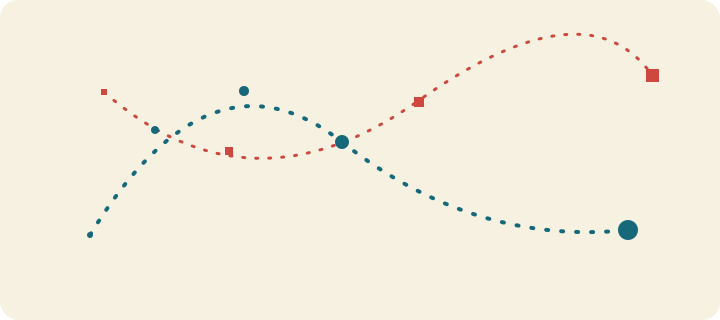
Objects carry short, limited memories through a fixed-step world.
A particle is a small record containing position, velocity, age, lifetime, and a short trail. A particle system owns many records and repeats the same update for each one. Age says how long an object has existed; lifetime says when it must disappear.
Use the course’s credited precedent notes to identify a particle or trail mechanism, not a final frame to reproduce. Credit creators, then change shape, emission, force, history, palette, and composition.
Vectors own complete objects
std::vector
can store complete Particle objects rather than parallel arrays. A constructor
receives position, velocity, and lifetime, establishes age == 0, and stores
the initial history point. Emitter owns the vector and moves complete records
into it.
Growth and erase can invalidate references, pointers, and iterators, so do not
retain one across spawn or removal. Explicit maximum_particles and
maximum_history values bound memory and work. History stays oldest-to-newest;
a range erase removes all excess oldest points at once.
One fixed update has an explicit order
The model uses this semi-implicit order:
v = (v + acceleration * fixed_dt) * exp(-drag_rate * fixed_dt)
position = position + v * fixed_dt
age = age + fixed_dt
The new velocity moves position. Exponential drag is time-scaled:
exp(-r * 0.5) equals two factors of exp(-r * 0.25), so damping does not
depend on render frequency. Configuration, time, state, and intermediate values
must be finite. An overflowing update leaves the particle unchanged instead of
spreading NaN.
A legal center lies in [radius, width - radius] and the matching y interval.
Crossing an edge clamps the center and reflects only outward velocity, scaled by
restitution. A viewport smaller than one diameter has no legal interval, so the
frame is rejected before simulation.
Expiry and removal are separate
A particle expires at age >= lifetime, including equality. Removing while
incrementing an index can skip adjacent expired objects, while erasing inside a
range-for loop invalidates its iterator. Use
std::remove_if
to move survivors forward, then erase the returned tail:
particles.erase(std::remove_if(particles.begin(), particles.end(), expired),
                particles.end());
Tests remove adjacent and separated expired objects together and preserve survivor order.
Render time feeds a limited fixed-step accumulator
Render frames do not define simulation steps. This model uses a bounded version of Fix Your Timestep! :
- reject negative or non-finite frame time;
- clamp accepted time to
maximum_frame_timeand record excess as dropped; - add accepted time to the accumulator;
- simulate at most
maximum_catch_up_steps; and - drop additional whole steps while retaining only a substep remainder.
The cap prevents an unlimited catch-up loop. FrameResult and the emitter total
record dropped time rather than pretending every elapsed second was simulated.
The spawn clock advances inside fixed steps, not draw calls. Each cadence makes at most one particle because cadence is at least one fixed step. Capacity suppresses extra spawns. An explicit random seed repeats the same launch sequence, including seed zero; another seed must vary it.
Pause, reset, and reduced motion keep promises
P toggles pause and clears the accumulator, so resume uses only newly supplied time. R resets particles, clocks, dropped time, origin, and seed. M hides trails while retaining current heads and controls. Pointer or drag and arrow keys move the same origin through the openFrameworks event adapter .
Current heads need a non-color age cue when trails are hidden. The solution keeps a full-radius triangular outline while an interior triangle grows from 35% to 80% of radius with normalized age. Tests inspect numbers and bounds; contrast, input access, motion, and originality remain manual checks.
Practice
Practice is guided and has no unit-test gate. Calculate two updates, inspect the saved oracle, build the adapter, and observe the fixed-step controls.
1. Calculate one particle twice
Start at x = 10 with vx = 10, zero acceleration, drag rate 1, and fixed
step 0.25 second. For each step calculate:
drag = exp(-1 * 0.25)
vx = vx * drag
x = x + vx * 0.25
Predict velocity and position after one and two steps. Compare one half-second
update with two quarter-second updates and explain which position differs under
semi-implicit integration. Decide whether a particle at exactly
age == lifetime remains alive.
2. Inspect the independent values
Linux or macOS:
cat exercises/09-particles-with-memory/fixtures/particle-oracle.txt
Windows Developer PowerShell:
Get-Content .\exercises\09-particles-with-memory\fixtures\particle-oracle.txt
Confirm first velocity about 7.788008 and first position about 11.947002.
Trace how the fixture’s update order produces those values.
3. Build and explore the adapter
Set OF_ROOT to openFrameworks 0.12.1. Linux or macOS:
scripts/section-09.sh generate --project starter
scripts/section-09.sh build --project starter --configuration Release
exercises/09-particles-with-memory/starter/bin/starter
Windows Developer PowerShell:
.\scripts\section-09.ps1 generate -Project starter
.\scripts\section-09.ps1 build -Project starter -Configuration Release
& .\exercises\09-particles-with-memory\starter\bin\starter.exe
Move the origin with pointer and arrows. Pause for several seconds and resume; there should be no burst. Try R and M, resize wide, narrow, and smaller than one diameter, and inspect all four edges.
4. Compare history with reduced motion
Follow one current head from spawn to expiry. Note the oldest-to-newest trail order, then press M and confirm that the current position and age cue remain visible without history. Reset and verify that the same seed produces the same early motion. This is an observation task; Exercise tests the numeric contract.
Exercise
Problem: build a limited history-trail emitter
Create a std::vector<Particle> system with explicit cadence, seed, fixed-step
and dropped-time rules, safe expiry removal, radius-aware boundaries, and capped
oldest-to-newest history. Choose lifetime, drag, acceleration, restitution,
launch speed, palette, and a visual language unlike both examples. Keep pointer
and keyboard input, pause, reset, and reduced motion usable.
Open the
Exercise 09 brief, starter, tests, and solution
,
then edit starter/src/design/particle_design.cpp and
starter/src/ofApp.cpp. Keep makeParticleDesign() and the declarations in
shared/particle_model.h unchanged.
Run the unit tests
Linux or macOS:
CXX=g++ tests/run-section-09-tests.sh
CXX=clang++ tests/run-section-09-tests.sh
Windows Developer PowerShell:
.\tests\run-section-09-tests.ps1
Tests parse the independent integration oracle and check cadence, spawn count, frame partitions, capped catch-up and dropped time, pause spikes, expiry at equality, simultaneous safe removal, exponential drag, all four edges, history order and cap, replay, seed variation, finite extremes, tiny bounds, and your design choices. They use neither pixels nor a real clock.
For one test-driven repair, temporarily change the expiry predicate in
shared/particle_model.cpp from p.age >= p.lifetime to p.age > p.lifetime.
Predict the equality failure, run the suite, restore >=, and require a green
run. Then generate and compile starter and solution in Debug and Release and
inspect both input routes.
Quick visual check
- Pointer and arrow keys move the same emitter; P, R, and M work.
- Pause resumes without a burst, reset repeats, and reduced mode hides trails.
- Nothing flashes and no state depends on audio or color alone.
- Current heads and an age cue remain visible without history.
- Palettes and text have suitable contrast.
- Resize, all edges, and tiny viewports stay safe with full strokes visible.
- Geometry, cadence, forces, trails, and palette differ from both examples.
- Alt text names trajectory, memory order, boundary contact, shapes, and palette.
- Reused references and assets are credited.
If you get stuck
Inspect one particle through one fixed update. Check dt, velocity, age,
lifetime, and history size before looking at the whole cloud. Keep every count
limited: a beautiful sketch that allocates forever is a glitter-covered leak.